
K-drama release schedule for 2026
J-drama release schedule for 2026
Thai-drama release schedule for 2026
Ha Young Apologizes for Her Great-Grandfather


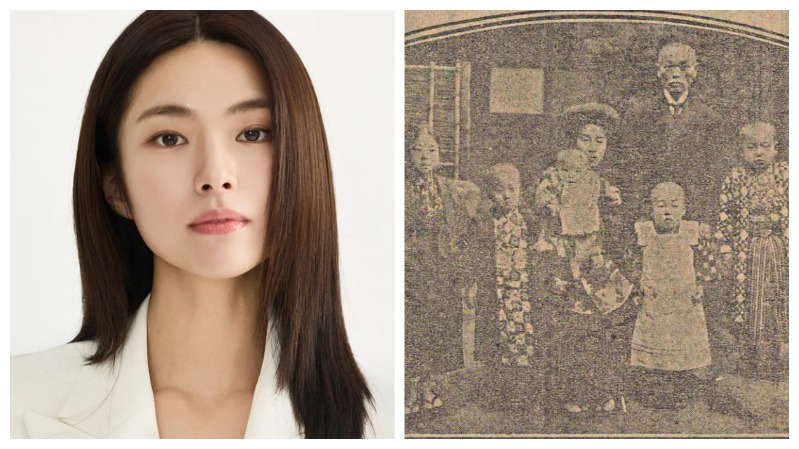
Actress Ha Young has been compelled to issue an apology on behalf of her great-grandfather.
Earlier, during an appearance on a KBS entertainment program, she mentioned that her great-grandfather was one of Korea's first Western-trained physicians, having studied in Japan and treated Emperor Gojong. Following the broadcast, the identity of her great-grandfather was established as Ahn Sang Ho. Online records were uncovered indicating his involvement with the pro-Japanese organization «Daejeon Chinmokhoe» in 1916, where he was listed as a council member. The organization dealt with economic matters, legal compliance, and tax discipline, while also advocating for «unity and harmony between Japanese and Koreans» — which in effect meant supporting the policy of assimilation and Japanese occupation.
Read more: «The Long Shot Trial» Comes Under Fire Over Ha Young's Pro-Japanese Ancestry Scandal
A scandal erupted. Given that all this is unfolding in the first half of August, with Korea celebrating Liberation Day on August 15 — commemorating its liberation from Japanese occupation in 1945 — when patriotic sentiment runs high, the situation for the actress has turned particularly awkward.
On August 7, the series «Our Sticky Love» - a romantic comedy starring Jung Hae-in and Ha Young - was released. The drama currently ranks second in the global Netflix rankings. However, in the wake of the scandal, Netflix has effectively put promotional activities on hold and is closely monitoring public reaction. All scheduled interviews, including those with Jung Hae-in following Ha Young's appearance, have been cancelled.
The production team of the SBS drama «The Long Shot Trial», in which Ha Young plays the lead role, is also on edge. The drama is nearly complete, making any changes extremely difficult.
The Korean daily The Fact writes:
"This situation could serve as a vivid example of why a celebrity must exercise extreme caution with every word, every detail of their family history, and every past statement they have made.
We cannot demand flawless historical knowledge from celebrities. Moreover, we must be cautious about placing precise responsibility for the actions of ancestors on their descendants.
However, the situation changes when a person proudly shares their family history in public. Especially when it involves historically significant figures or events, it is necessary to exercise caution and double-check the facts before speaking."
The position is clear: it is better to remain silent than to speak; if you speak, verify; if you have said too much, apologize.
But allow us to express some doubt. On what basis does the public, whether the person is a celebrity or not, have the right to dictate whether someone should be proud of their ancestors or not? After all, these are the ancestors of a specific individual, and it is entirely a private family matter that does not require public approval.
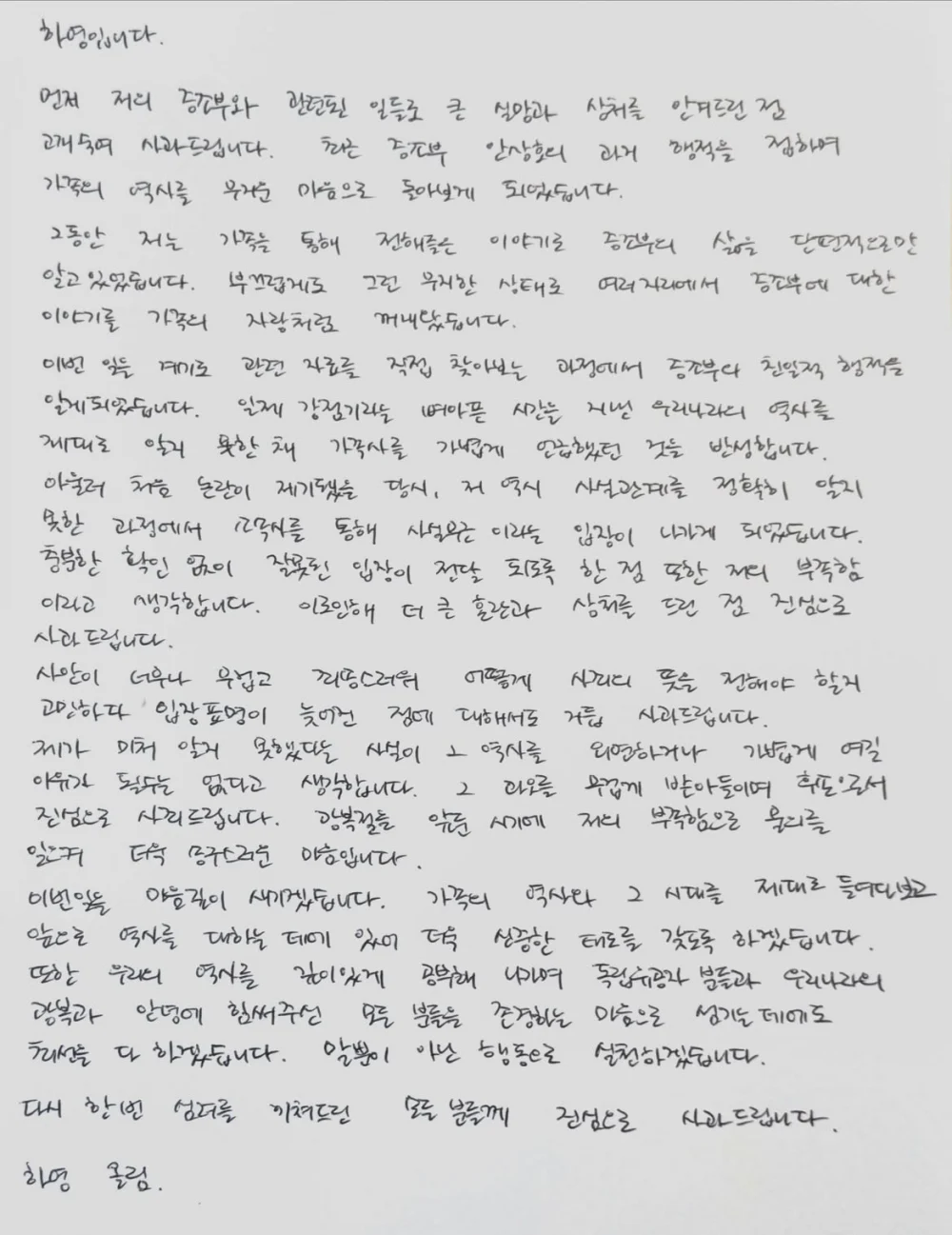
Ha Young wrote in her statement:
"I only knew about my great-grandfather's life in fragments, based on stories I heard from my family. To my shame, in such ignorance I spoke about my great-grandfather's stories as if they were a source of family pride. I bow my head in apology for the great disappointment and pain I have caused."
We see that the family history surrounding this great-grandfather clearly contains some accounts that speak of him as a good and worthy person.
Even if this particular great-grandfather's organization was indeed odious, Korea at that time was part of Japan, and within society there were complex and deeply ambiguous processes of building national consciousness. Among both Japanese and Koreans of that era, there existed different and, perhaps, equally viable and equally likely as historical possibilities views on how to move forward. And the idea that Korean identity should be preserved rather than assimilated into the technologically and socially advanced Japanese way of life was far from obvious to everyone.
Let us recall that each of us has at least 16 great-great-grandparents, 8 great-grandparents, 4 grandparents, and 2 parents who lived through the very challenging 20th century — far removed from the ethical and moral heights of the first quarter of the 21st century. It is hardly possible to properly apologize for all of them and for everything, as the standards of what one should apologize for are constantly changing.
But of course, it is very comfortable and easy to condemn ancestors (especially other people's) for not living as you imagine to be ideal.
Ha Young also wrote:
"I regret even more that I caused concern due to my own shortcomings. I will properly study my family's history and the era in which they lived, and in the future, I will approach our history with greater caution and responsibility."
She also expressed respect for independence fighters and those who contributed to Korea's liberation, adding:
"I will embody this through my actions, not just my words. Once again, I sincerely apologize to everyone who has been concerned or hurt by this."
It is worth asking: did Mr. Ahn Sang Ho cease to be a good doctor simply because he found the Japanese path of development more promising for himself and his country? And should the family be deprived of the right to be proud of him as a good physician and organizer of Korea's medical system (if he truly was a good doctor — after all, they would not have sent just anyone to treat King Gojong)? And for how many generations must his descendants continue to atone?
Of course, it should be noted that Ahn Sang Ho studied Western medicine in Tokyo, where he graduated from college in 1902. But this is logical, because Japan at that time was the nearest and most developed country in Asia in terms of medicine. Not everyone had the opportunity to study in Europe or America. One's alma mater certainly exerts a powerful influence for the rest of one's life. But one cannot seriously consider a person who studied outside their homeland to be a "damned foreign agent" (although there are some people who indeed suggest exactly that).
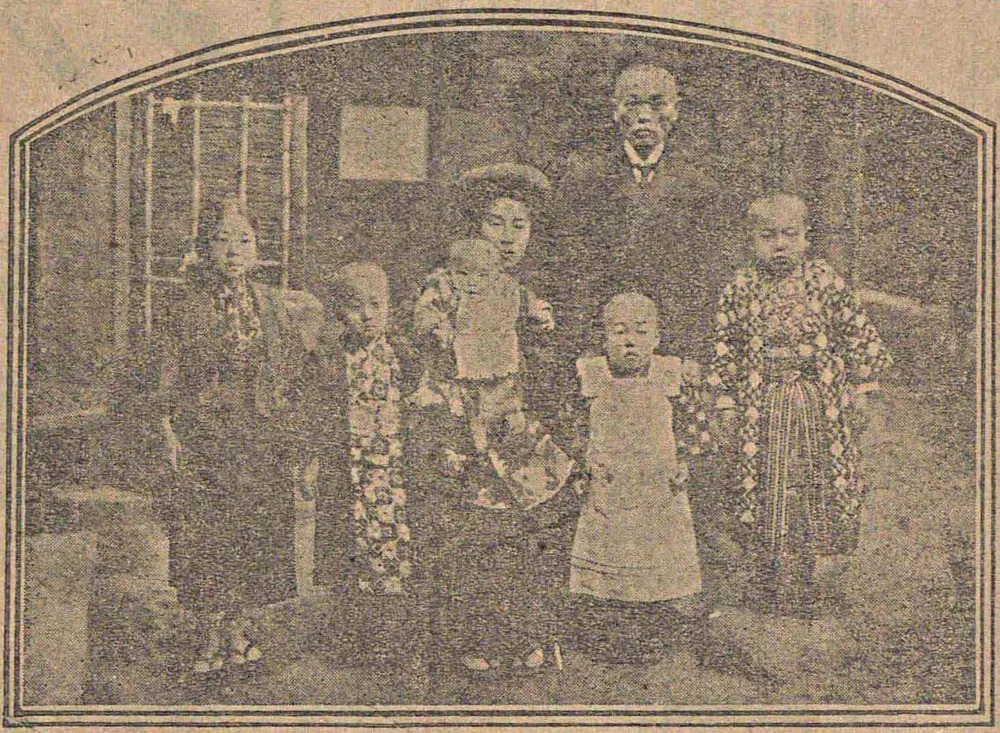
Historian Shim Yong-hwan, writing in Edaily, has called for a return to rational discourse.
Ahn Sang Ho was born in 1872 and died in 1927. The events related to the Japanese occupation pertain to the last eight years of his life.
It is dangerous to label him a "pro-Japanese collaborator" based solely on membership in a particular organization, especially when no specific acts of collaboration with Japan have been clearly established, Shim Yong-hwan emphasizes. He pointed out that there is one academic article on the subject by Professor Lee Jeong-eun, and that article does not confirm that Ahn Sang Ho was a pro-Japanese collaborator.
Shim Young-hwan draws everyone's attention to the fact that hastily attaching labels does not strengthen but rather blurs the criteria for evaluation:
"Above all, if we hastily label someone as a ‘pro-Japanese collaborator,’ far too many people from the past could be categorized as such, and ultimately, the very criteria for what constitutes pro-Japanese collaboration—and what we should criticize and remember—could disappear.
I hope we can establish clearer criteria for defining who qualifies as a 'descendant of an independence fighter.'
Just as collective punishment is wrong, the merits of one’s ancestors cannot be considered one’s own.
We must now reach a conclusion regarding what constitutes a ‘descendant of an independence activist’ and what rights and responsibilities should be associated with that status," he stated.
The actress's detractors might also do well to consider what would happen if, among Ha Young's 16 great-great-grandparents and 8 great-grandparents, there were to suddenly emerge impeccably honest and great fighters against Japanese occupation or defenders of the homeland during the Korean War of 1950–1953. Such a thing is also possible. Family lines can sometimes intertwine in very intricate ways. For example, Pushkin and Tsar Nicholas I had common great-grandchildren — who would have thought?
Forgive these lengthy reflections, but this editor-historian finds all of this deeply distressing and feels like crying out: "Leave history to the professionals, and please reserve your moralizing for more relevant issues."
And finally, an old, old story about the history of Russia:
"As soon as Lenin died, it turned out that the second man in the party, Comrade Trotsky, was a traitor. Kamenev, Zinoviev, Bukharin, and Stalin overthrew Trotsky and expelled him from the USSR.
But a couple of years later, it turned out that Kamenev, Zinoviev, and Bukharin were also enemies and saboteurs. Then the valiant Comrade Yagoda arrested them.
A little later, Yagoda was arrested as an enemy agent by Yezhov. But a couple of years later, it turned out that Yezhov was also not a comrade, but an ordinary traitor and enemy agent. And Yezhov was arrested by Beria.
After Stalin's death, everyone realized that Beria was also a traitor. Then Zhukov arrested Beria.
But soon Khrushchev learned that Zhukov was an enemy and conspirator. And he exiled Zhukov to the Urals.
And a little later it came to light that Stalin himself had been an enemy, a saboteur, and a traitor. Along with him, a large part of the Politburo. Then Stalin was removed from the mausoleum, and the Politburo, along with the joined Shepilov, were disbanded by honest party members led by Khrushchev.
A few years passed, and it turned out that Khrushchev was a voluntarist, an adventurer, a charlatan, and an enemy. Then Brezhnev sent Khrushchev into retirement.
Soon Brezhnev died, and it turned out that he had been a saboteur and the cause of stagnation. Then there were two more, whom no one even had time to remember. But then a young, energetic Gorbachev came to power. And it turned out that the entire party had been a party of saboteurs and enemies, but he would fix everything now.
That was when the USSR fell apart. And Gorbachev turned out to be an enemy and traitor... To be continued."
* Если в данной статье упоминается Facebook или Instagram, мы информируем вас, что данные соцсети запрещены в РФ, а компания META Platforms Inc. признана экстремистской.
Прислать свою новость или сообщение о предстоящем мероприятии/событии вы можете здесь.


Читать также
«Игра в кальмара 2» стала третьим по популярности сериалом на Netflix...
Он лидирует на платформе уже третью неделю подряд.
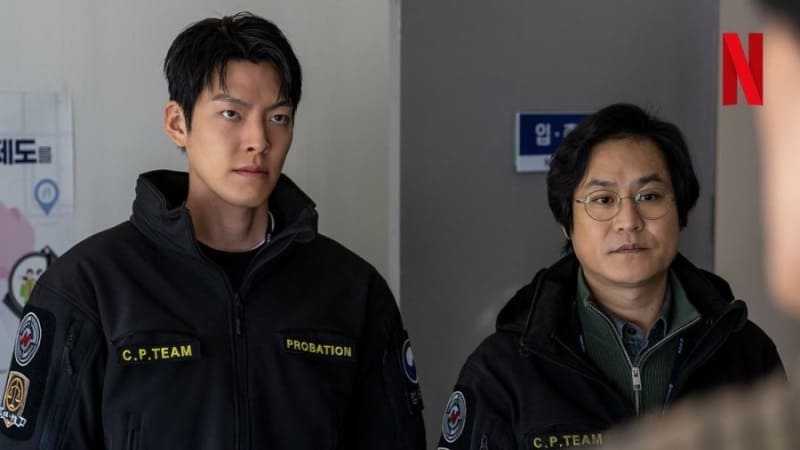
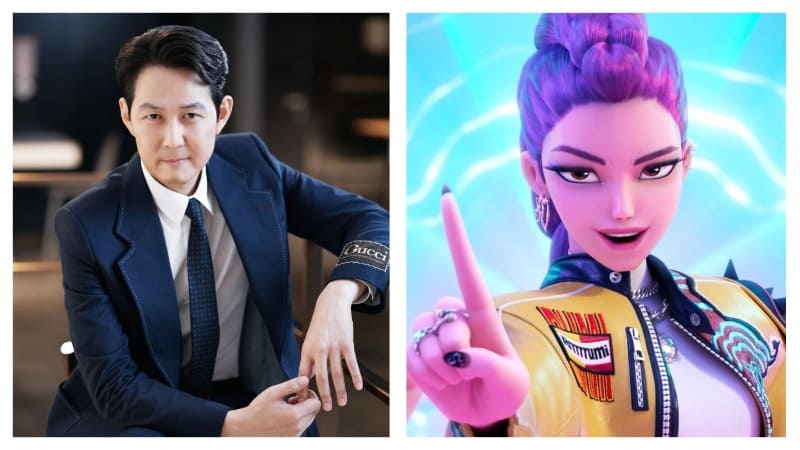
В новых фильмах K-pop айдолы превратятся в охотников за демонами и агентов под прикрытием...
Международная индустрия кинопроизводства обратила внимание на K-pop индустрию.

Даниэль из NewJeans посетила мероприятие OMEGA в сопровождении сотрудников ADOR...
Сообщается, что мероприятие было запланировано давно.

Ли Джэ Ук и Го Мин Ши сыграют в сериале Netflix «Идеальная работа»...
Сюжет этого мистического хоррора будет разворачивается вокруг странного агентства по трудоустройству, которое предлагает «идеаль...

10 самых милых корейских дорам для новогодних каникул
Если вам хочется посмотреть что-то легкое, веселое и со счастливым финалом.
 ФанАзия